
We are heading to the port once again. Not to find a cruise ship this time – today we join the queue for Fred Olsen’s huge trimaran ferry over to La Gomera, the smaller island we can usually see from many nearby vantage points, and just 20 miles from our house, although the haze renders it invisible today.
A grumpy member of staff tells us we’re not booked in, of course he’s wrong, and after typing our registration in again, suddenly we are booked in after all! We join the tail-end of the queue and are one of the last to board, which is to advantage later.
The journey across is calm but uninspiring as the haze means we have nothing to see until suddenly the cliffs of San Sebastián are looming over us as we reverse into port. Within minutes we’re exiting the ferry, driving through town and heading up up up the GM2, one of only two routes out of San Sebastián.
We stop first at Roque de Agando, a beautiful towering peak or dome. These domes were considered spiritual by the original settlers and the remains of sacrificed animals are still found nearby. We head off walking upwards towards a viewpoint. Not content with this one, we continue up towards the next and then the next again.


This visit will not be about distance, the terrain is tough, but around every corner there is another stunning view so we will need to find as many as possible. The other beauty is the quiet, as we find ourselves quite alone – on our first walk we enjoy the silence of the route as it diverges from the road.


We drive on another few km to Aparcamiento de Cruce de Pajarito, a car park at the junction of three roads, and the gateway to the island’s highest point at Alto de Garajonay. It’s only a km to walk, but again tough going. This time there are a few more folk enjoying the view, several eating lunch as we do too. We can see back to Tenerife, La Palma, and El Hiero despite the haze – on a clear day the views must be astonishing from this place almost one mile above sea level.


Heading back to San Sebastián we stop briefly at a local church which has become an attraction because it is dedicated to Our Lady of Health, people make pilgrimage here. After this we slowly descend into town and then uphill to the Parador perched on the cliff above the harbour to check in.


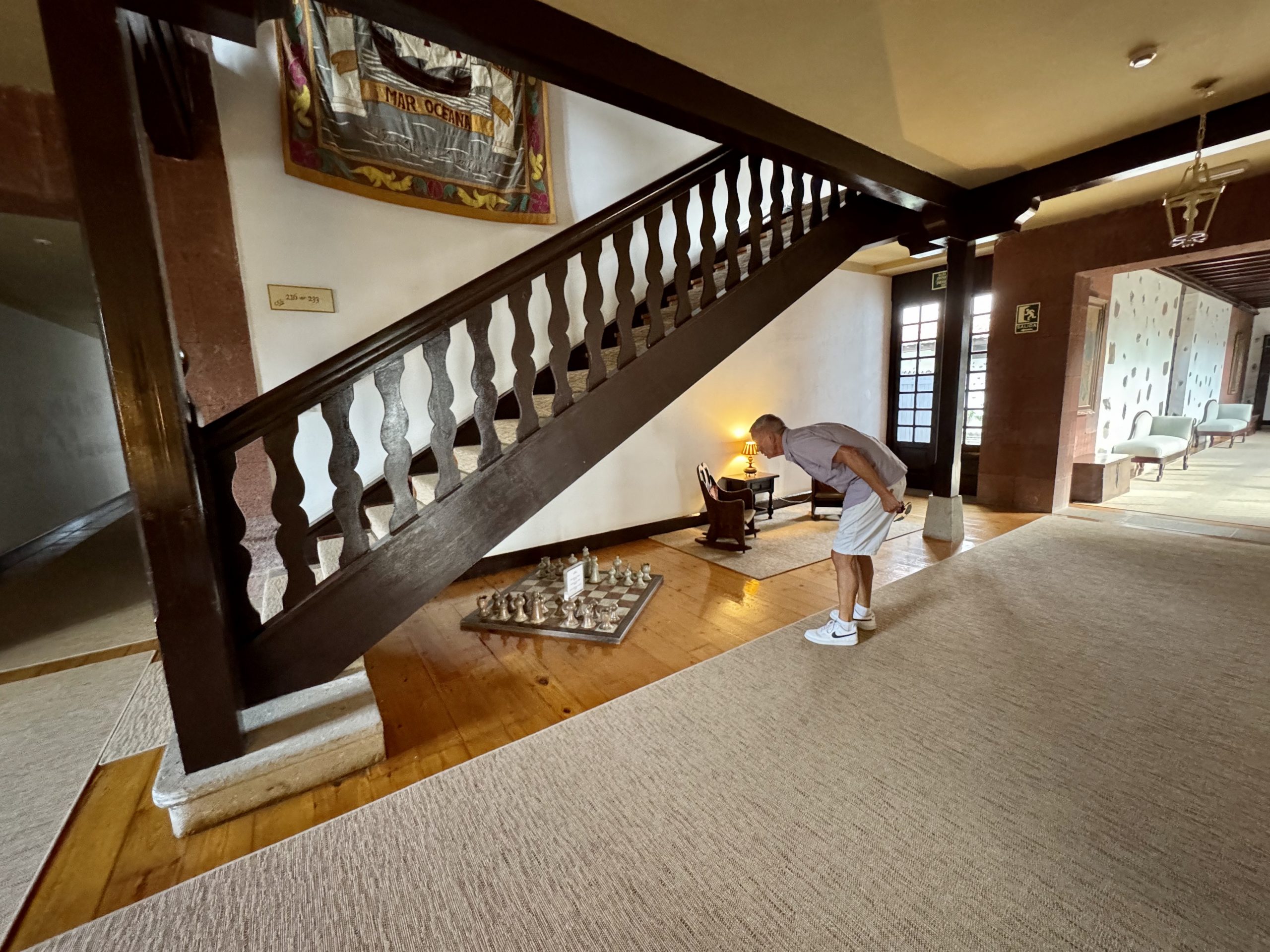
Paradores are a peculiarly Spanish affair – state owned hotels, about a hundred in total, many in old and treasured buildings and some quite new, occasionally in areas of special interest such as the one on Teide where no commercial chain would ever be allowed to build. This one is a gorgeous rambling affair dating back to 1928, with extensive grounds and perched on a cliff right above the port of San Sebastián.


After a much-needed beer we decide to wander around the upper town, taking a cliff-top pathway in a big loop past the old and new lighthouses, before we return to get an aperitif from the bar, then repair to our veranda to read and write for a while.


We dress for dinner, and head down to the dining room to enjoy ibérico croquettas and squid fritter croquettas followed by cherne (grouper) and pork rib. We finish with a shared grandma’s cake in chocolate sauce.


